
Trace a Nashville Street by Address
Start a Nashville street search with a numbered address. It identifies one parcel before names, mailing addresses, and historic listings overlap. Parcel records identify the current tax owner and situs, or mapped, address; recorded instruments establish legal title. Voter data confirms a known person, while a period directory offers a dated household clue. An owner may be a trust, company, estate, or tax-notice recipient, and a directory address is only a listing for its publication year.
- Enter the street number and name in the Parcel Viewer or Assessor search. Save the situs address, parcel identifier, legal description, and retrieval date.
- Read the current-owner and mailing fields as property context. A mailing address can help distinguish records, but it does not establish where that owner lives.
- Use the owner name, recording date, legal description, and prior-reference details to follow the deed chain through the Register of Deeds.
- For a known person, use Tennessee's voter form as a confirmation step with the required name and birth fields. It is not a street-wide browser.
- Finish with a period criss-cross listing at Metro Archives, then label the result as a historical address listing rather than a current household claim.
Nashville Address Parcel Search
The Metropolitan Nashville and Davidson County Assessor of Property accepts owner, address, and parcel searches. Start with Davidson County and a property address. Street number is optional there, so check the returned situs and parcel. The parcel record can supply a current owner, tax mailing address, values, sale information, exemptions, and linked deed or map material.
The Tennessee Property Assessment Data search shows the address and parcel controls used to narrow a Nashville property query.
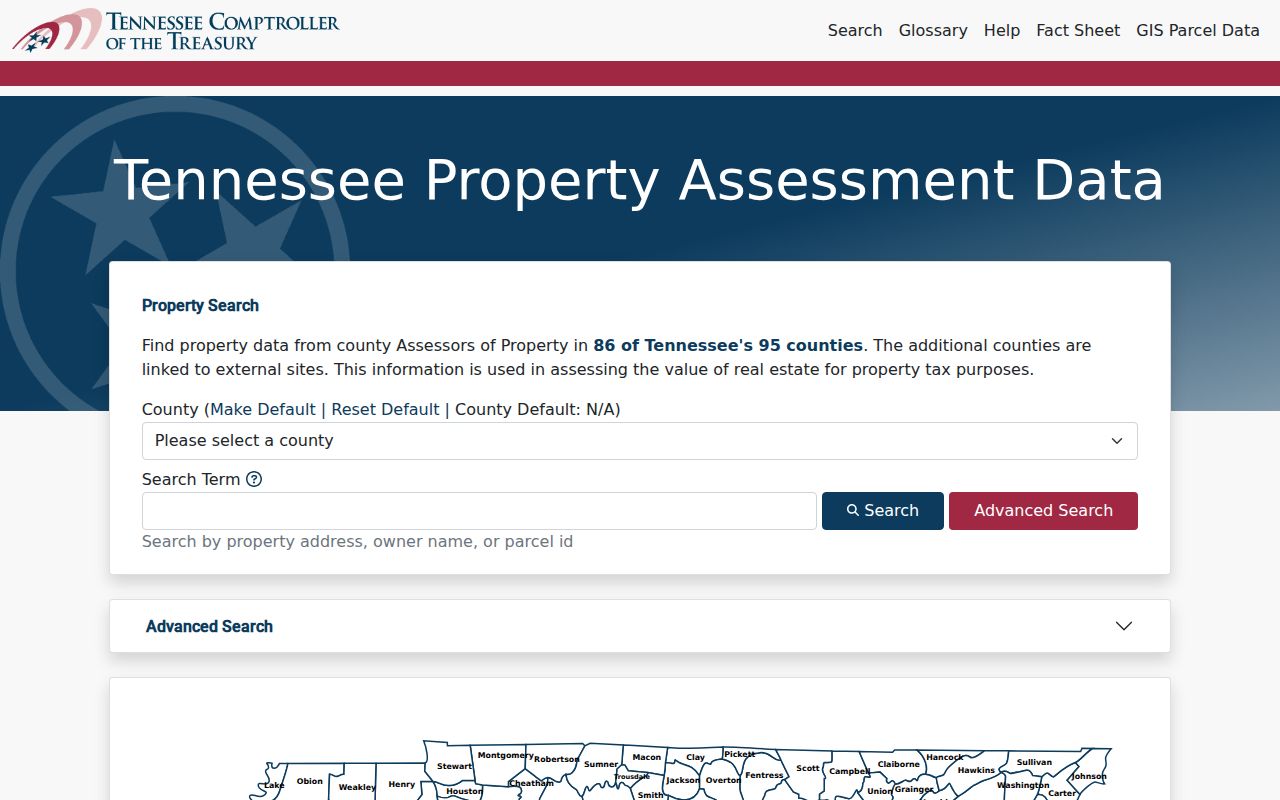
Use its result as an identification record, then compare the property address, map-parcel number, and owner with the Nashville-specific parcel and deed sources.
| Tool | Field or control | Nashville street-search use |
|---|---|---|
| Tennessee assessment data | County, Owner Name, Property Address | Select Davidson County; the street number may be omitted in the address search. |
| Tennessee assessment data | Subdivision, Classification, Sale Date | Optional refinements when a street has similar addresses or several parcels. |
| Tennessee assessment data | Control Map, Group, Parcel | Parcel ID is split into these parts; the parcel can anchor later searches. |
| Parcel Viewer | Parcel Address or Intersection, Current Owner, Street Name | Core Nashville GIS controls for locating a street segment or a known parcel. |
| Parcel Viewer | ZIP, sale, zoning, land use, districts | Advanced filters add location context, not a household list. |
Nashville Street GIS Fields
Nashville Parcel Viewer adds the spatial part of a street-by-street search. It offers Parcel Address or Intersection, Current Owner, Street Name, and Custom Shape modes, plus filters for parcel ID, city, ZIP, sales, zoning, land use, and districts. The Viewer reports daily updates, but Metro also says it is not a survey, legal description, title search, or official tax record. Use its boundaries and map tools to identify a parcel, then verify ownership through the recorded instrument.
The Nashville Parcel Viewer displays the parcel, address, owner, street, ZIP, and sale-oriented search environment.
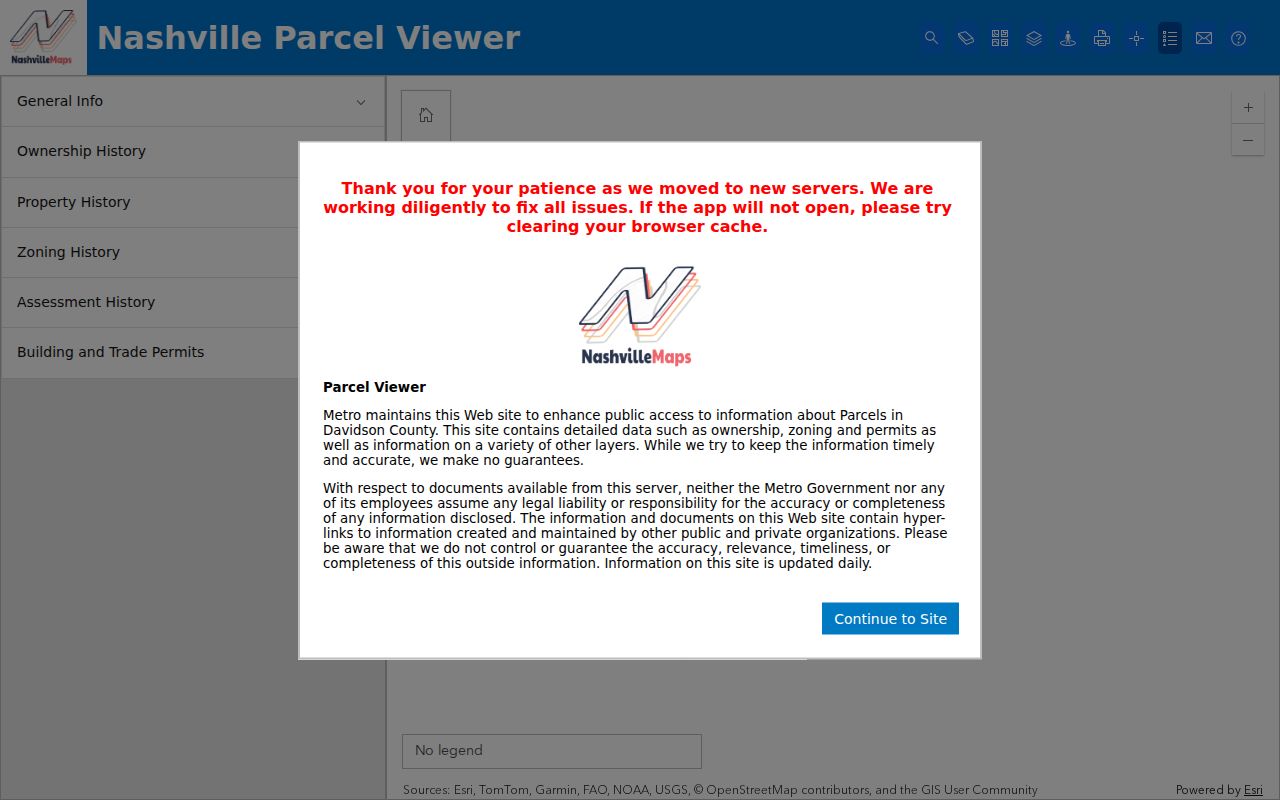
Adjacent parcels and an exported result table can describe the physical block, while each owner and mailing field still needs to remain attached to its own parcel record.
Metro GIS Mapping Services describes cadastral maps as covering every parcel in Metro Nashville.
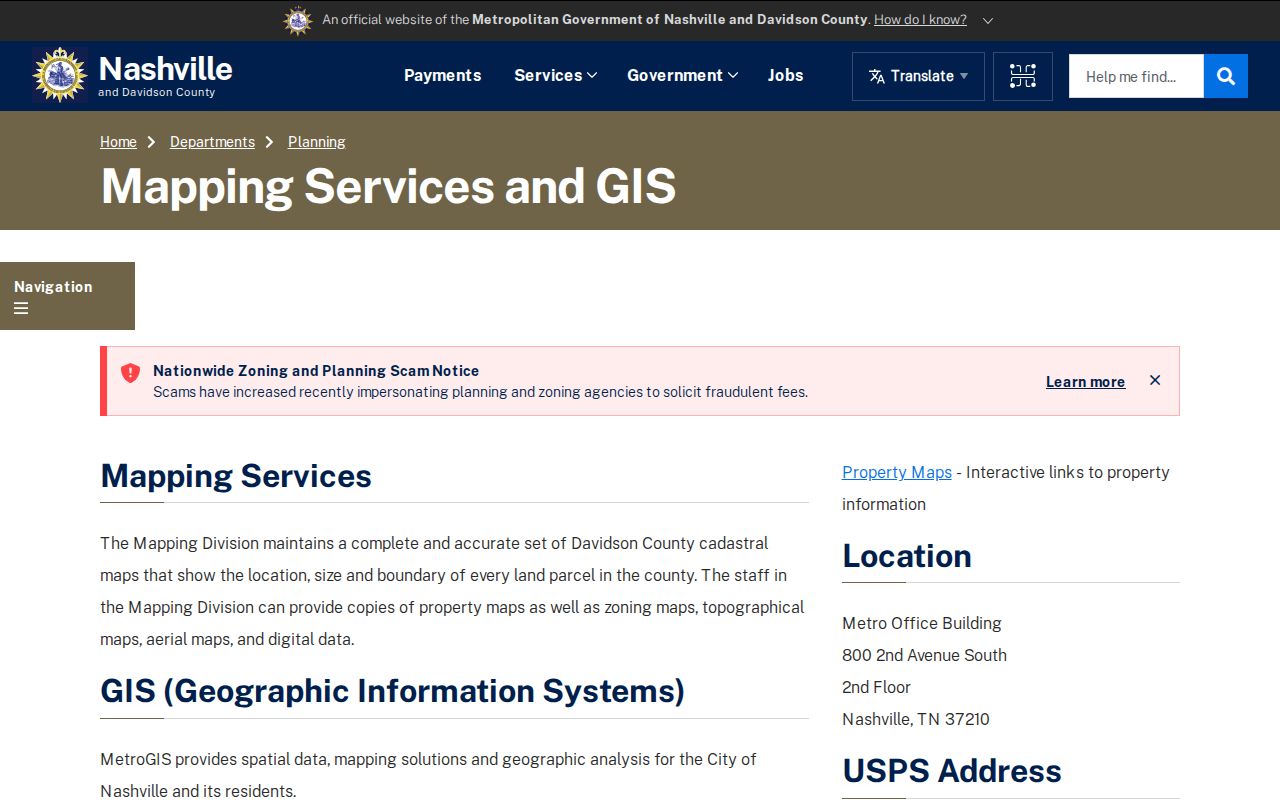
That map scope helps locate a parcel, but it does not add a separate resident list.
- Parcel
- A legal and tax unit shown as a mapped boundary. It is not the same thing as a household.
- Situs address
- The taxable property's mapped address, which may differ from the address used for owner correspondence.
- Plat
- A recorded map of lots or a subdivision. Metro Archives holds plats from 1855 through the late 1990s.
- Criss-cross directory
- A period directory arranged by address or street, useful for seeing how a particular publication listed an address.
Note: Parcel Viewer boundaries help locate property, but the recorded deed supplies the legal ownership trail.
Nashville Deed Chain by Street
The Davidson County Register of Deeds internet service is the legal-document step in a street directory trail. Its searchable online name-and-date index begins July 1, 1964, while scanned images reach from 1784 to the present and archive index books are online. DavidsonPortal access is subscription-based at $50 each month for one user, with each additional user at $25 per month. Older searches may therefore need the archive books, Metro Archives deed-index microfilm from 1784 to 1924, original deed books, or TSLA microfilm rather than a modern portal name search alone.
Search grantor and grantee spellings, read the instrument's prior reference, and work backward one recorded transfer at a time. A deed chain traces title, not daily presence at the address.
| Party name | Grantor, grantee, or another indexed party name. Spelling is a key search variable. |
|---|---|
| Recording or search date | The date field used with the online modern index, which begins July 1, 1964. |
| Document type | A post-2000 filter; the office lists deeds, deeds of trust, releases, liens, plats, and powers of attorney among its record types. |
| Lot or subdivision | Searchable for records from January 1, 2000, when present. |
| Book, page, or instrument reference | A placement reference on the recorded instrument; older material also uses archive books and images. |
| Image access | Scanned images are stated as available from 1784 to the present, subject to the office's service and policy rules. |
Note: Archive books and microfilm are essential fallbacks when a deed date falls outside the modern searchable index.
Nashville Street Directory ZIP Checks
A ZIP filter can help narrow a Nashville street directory search, but it sorts parcels by postal routing rather than by a city boundary or a neighborhood line. Parcel Viewer includes Zip Code among its advanced controls and returns parcels, not a list of people. Check the returned street, city, parcel situs, and tax mailing address before carrying a ZIP label forward. The Metro GIS inventory places 37204 near 12 South, Belmont-Hillsboro, and Berry Hill vicinity, while 37205 can span Belle Meade, West End, and Hillwood context. Those are orientation clues, not fixed boundaries.
Two values need special care. Metro identifies 37232 and 37240 as Vanderbilt-associated institutional ZIPs. A campus or medical address should be marked as institutional when the address indicates it, not treated as proof of a person's residence.
Nashville Street Names Through Time
Street names can change while a parcel or family trail continues. The Historic Preservation street-name reports are a practical crosswalk when an older directory address disappears from a current map. Research notes current 2025-2026 examples, including Roehrig Court becoming Magnolia Shores and South Street becoming King Hollands Avenue, but each report should be checked before assigning an alias. Pair the report with a historic map, plat, deed, and street spelling rather than deciding that a changed name proves a move.
Metro took effect on April 1, 1963. Berry Hill, Belle Meade, Forest Hills, Goodlettsville, and Oak Hill retained municipal identities. Preserve the source's geography and date because a historic directory, deed, or ward label may differ from a current Metro record.
Note: Preserve the dated street spelling and place name before comparing a historic source with current records.
Nashville Permit Trail by Address
Metro ePermits provides a public, no-account inquiry path for permit and inspection information. Current searches can use a permit number, address, owner, or contractor. A permit summary can contain the permit type and number, associated property, inspection steps, signoffs, comments, and related child permits. Those fields can explain a property event, but an applicant or contractor name is not automatically an owner or an occupant.
The Metro ePermits public inquiry is the current address-oriented permit source for the Nashville street directory.
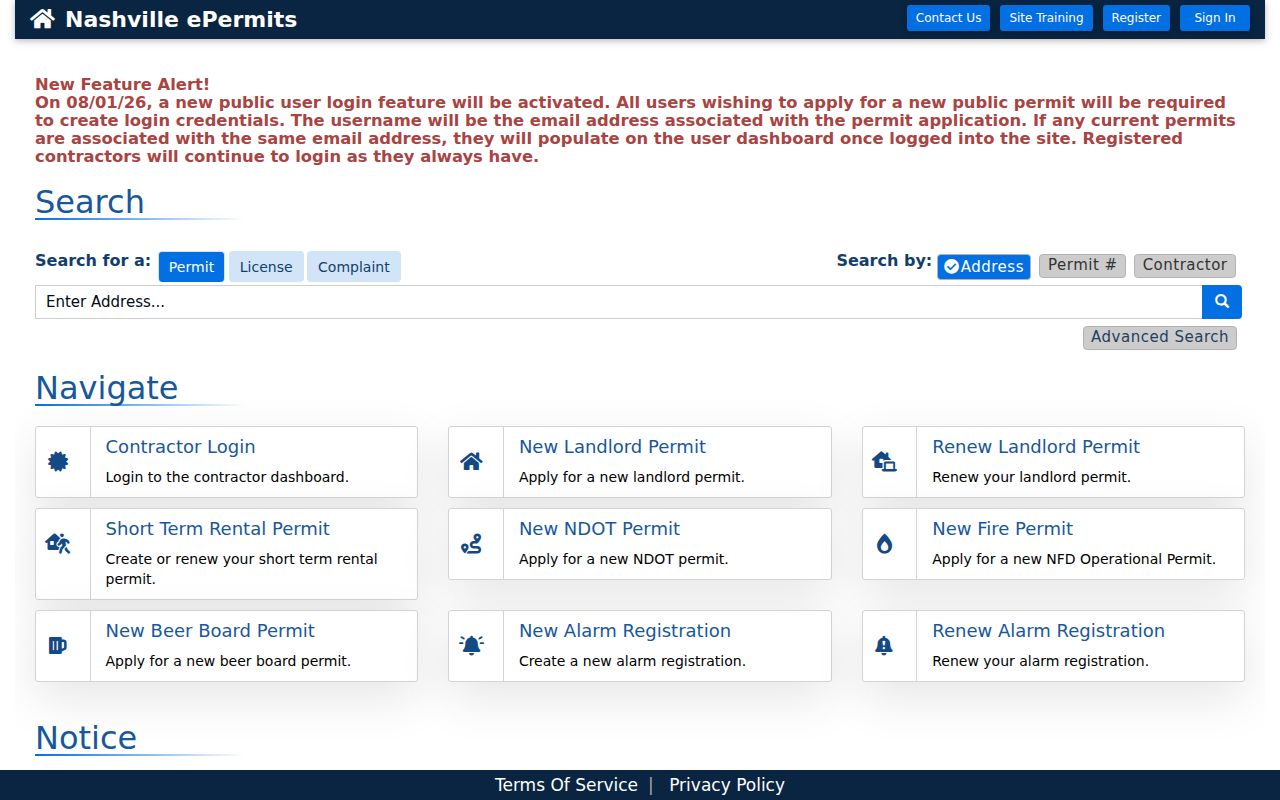
Legacy Codes Permit reports stopped appearing through the older portal on May 18, 2026, so a failed legacy search should be rerun in ePermits before treating the record as unavailable.
Nashville Codes by Street
Metro Codes keeps another address-keyed public-record channel. Its public-records material says ePermits can show construction, trade, property-standards, inspection-status, and violation-case updates, and that Available Reports may contain inspection reports and permit-tracking documents. The former ePAV search accepted permit number, street name, postal direction, street type, suite, ZIP, map parcel, and street number. Broad legacy requests could take several minutes or time out.
The Metro Codes public-records page identifies the address and parcel path for permit and inspection materials.
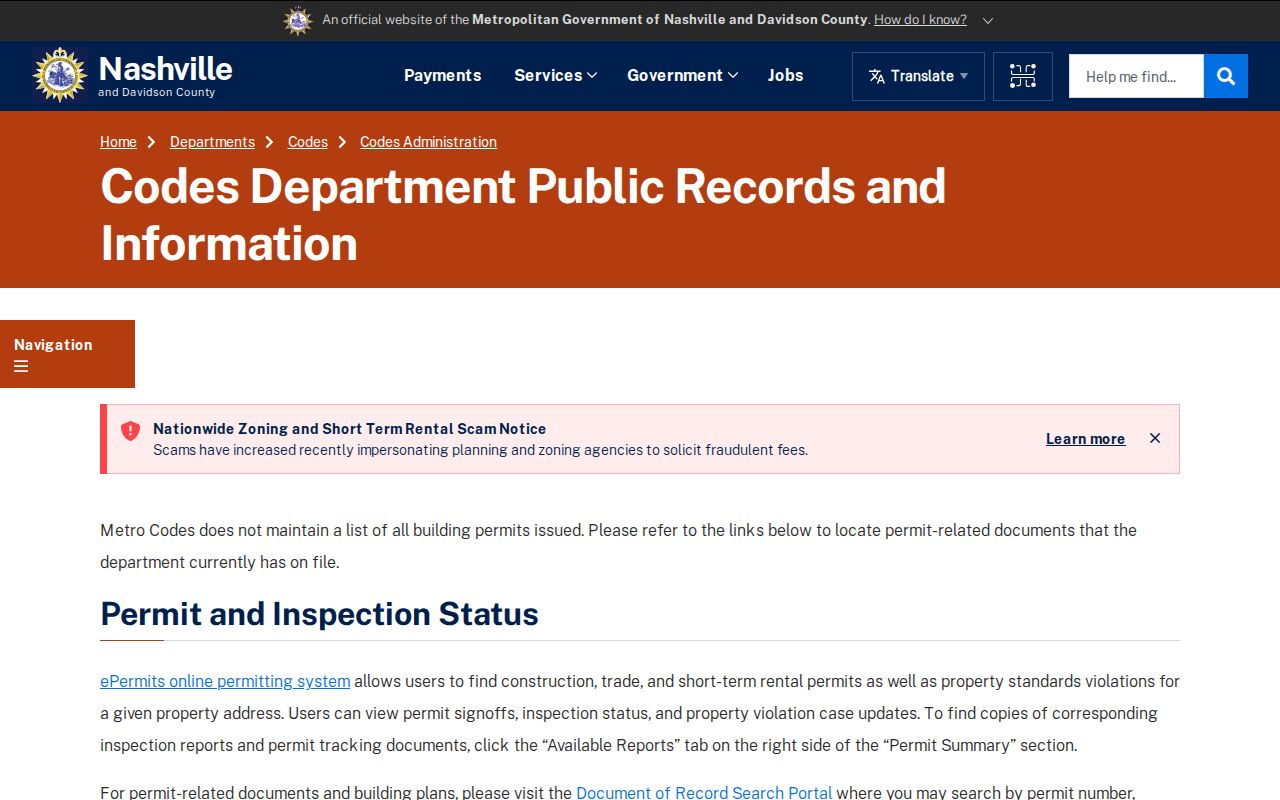
When a result names a property or permit, retain the record number, event date, and stated role so the street record is not mistaken for a current-residence statement.
Nashville Address History Crosswalk
For an older street trail, Metro Archives supplies a different access channel: original deed books to around the 1960s, deed-index microfilm from 1784 to 1924, plats, court material, city directories, newspapers, and vertical files. The archive's old-house research method pairs the current parcel identifier and deed with reverse searches for prior owners, street listings in directories, Sanborn maps, and plats. This sequence keeps legal title, building footprint, and household listing as separate kinds of evidence.
A direct index begins with a name and looks toward property; a reverse index begins with property and looks toward a name. A criss-cross directory is the address-arranged counterpart for a period listing. The Nashville Directory Book keeps the directory collections and their date ranges in one historical reference. A person shown at an address in one volume should retain that volume's year and any exact notation.
Note: A period directory entry records a listing for one year, not an undated household statement.
Nashville Address Records Coverage
No one Nashville system identifies everyone along a street. Each address-keyed source has a narrower job, access route, and limit. Pair results by parcel identifier, exact address, date, and record role rather than merging the names into one claim.
| Address-keyed source | Nashville custodian | What it can establish | Access and limit |
|---|---|---|---|
| Property and tax record | Assessor of Property | Current tax owner, situs and mailing address, parcel, value, sale, and exemptions. | Public portal; owner and mailing fields do not prove occupancy. |
| Parcel map and history | Parcel Viewer and Metro GIS | Parcel geometry, street context, ZIP, zoning, land use, districts, and documented history tabs. | Public viewer; not a survey, title opinion, or official tax record. |
| Recorded instruments | Register of Deeds | Transfers, liens, plats, legal descriptions, and the deed chain. | Modern search starts in 1964; use images, archive books, or microfilm for older work. |
| Permit and inspection material | Metro Codes | Address-linked permit, inspection, signoff, and case context. | Use current ePermits; roles in a record need separate interpretation. |
| Period directory listing | Metro Archives | A household or business listing for the volume's address and year. | Historical context only; it is not a current roster. |
Nashville Voter Confirmation Limits
The Tennessee voter lookup is a confirmation form, not a free-form street directory. It requires County, First Name, Last Name, Birth Month, and Birth Year, and Davidson County must be selected in the county control. Search a known person using the name as registered, including a middle name or initial when known. Record a displayed current-data date. A no-match calls for spelling review and contact with the Election Commission, not a conclusion that the person is absent from Nashville.
Davidson County Election Commission services include registration checks, address updates, voter-list access, and election statistics. Public permanent registration records have statutory limits and redactions. Safe at Home participant voter information is confidential, so an address or name cannot be reconstructed from a no-match or substitute-address result.
Nashville Street Directory Boundaries
A street directory result has real limits. A tax owner may be a trust, company, estate, or person receiving correspondence elsewhere. A situs address identifies the taxable property, while a mailing address identifies where tax notices go. Homestead and exemption fields can add owner-occupancy context but are not conclusive. The public parcel card does not provide Social Security numbers, driver-license data, confidential utility information, or protected addresses. Treat every field as a record of its stated role and date.
Lawful use. Nashville address records support personal, lawful research and source checking. Never use them to stalk, harass, intimidate, or harm a person, and do not attempt to expose a protected address.
Note: Record roles and dates prevent an owner, a directory listing, and an address from being merged into one claim.
Nashville Records Request Routes
When an address record is not online, send the request to the custodian that holds it. Metro's centralized public-record route covers many Metro departments, but the Register of Deeds, court clerks, County Clerk, Sheriff, Police, and Health use their own routes. Name the likely department and describe the record by address, date range, parcel, permit, or instrument details. Under Metro policy, inspection of open records is free unless another law applies; copies and staff time can carry charges. Metro generally responds within seven business days with the record, a denial, a time notice, or a clarification request.
The Metro GIS Mapping Services office can assist with cadastral-map scope, while the Metro public-records request route helps identify the appropriate Metro department. The request should preserve the street name as recorded, including a historic spelling or municipal label when relevant.