
Nashville Address History Sources
Start with the time period, then choose the source that can actually speak to it. A present parcel and recorded deed anchor the address today. Archive deed books, index microfilm, and directories extend the trail backward. The household trail is not the title trail: a deed names parties to a legal transfer, while an address directory records a period listing. Nashville previous residents research is strongest when each result keeps its own date, repository, and role.
| Source | Years It Covers | Where Held | What It Shows |
|---|---|---|---|
| Register name-and-date index | July 1, 1964 to present | DavidsonPortal and Register of Deeds | Party, date, and recorded-instrument path for modern searches. |
| Recorded images and archive books | 1784 to present images | Register of Deeds service and archive books | Older recorded material when the modern searchable name index stops. |
| Deed-index microfilm | 1784 to 1924 | Metro Archives and TSLA | Direct and reverse paths for a property or party search. |
| Nashville city directories | 1853 to 2011 | Metro Archives; selected TSLA digitized volumes | Period names and addresses, with street addresses from 1910 onward. |
| Plats and Chancery material | Plats from 1855 to late 1990s; Chancery 1846 to 1935 | Metro Archives | Lot context and some partition, title, or equity matters. |
Use the current parcel identifier and legal description to connect sources. A street address can change, but the record trail can often be tested against the parcel, lot, subdivision, and prior instrument reference.
Nashville Deed Chain Backward
The Metropolitan Nashville and Davidson County Assessor of Property supplies the current owner, situs address, mailing address, parcel identifier, sales, and linked deed or map material. Use that parcel to begin a backward title search through the Register of Deeds internet service. A title chain follows recorded transfers, so it should remain distinct from a household history.
- Capture the current parcel, legal description, situs address, and owner from the Assessor or Parcel Viewer.
- Find the current recorded instrument and note its grantor, grantee, recording date, document type, book or page reference, and prior-instrument reference.
- Search the seller from that transfer as grantee to locate the earlier purchase, checking spelling variants in the direct and reverse paths.
- Repeat one instrument at a time. Record the party role and date rather than treating every named person as a past household member.
- When the chain reaches the online boundary, continue with archive index books, Metro Archives microfilm, original deed books, or TSLA microfilm.
- Grantor
- The party transferring an interest in a recorded instrument.
- Grantee
- The party receiving that interest. In an earlier purchase, a later seller may appear as grantee.
- Chain of title
- The sequence of recorded transfers used to follow legal interests in a parcel over time.
- Legal description
- The lot, subdivision, or other recorded property description that can remain useful when street names change.
- Criss-cross directory
- An address-arranged directory section that can connect a period street listing with a name.
The online service documents party-name and date searching. Lot number, subdivision name, and document-type filters are available for records beginning January 1, 2000. The public description does not expose every live result column, so preserve the book, page, or instrument reference as recorded instead of supplying a guessed format.
Nashville Previous Residents Index Boundary
DavidsonPortal's searchable name-and-date index begins July 1, 1964. That is a search boundary, not the beginning of Nashville's recorded history. The Register says scanned images are available from 1784 to the present and archive index books are online. The subscription service is $50 per month for one user, with $25 per month for each additional user. For past residents research before the online name index, the practical fallback is archive books, deed-index microfilm, original deed books, and Metro Archives assistance.
The Register of Deeds subscription service documents the modern index start, older images, post-2000 search additions, and archive-index access.
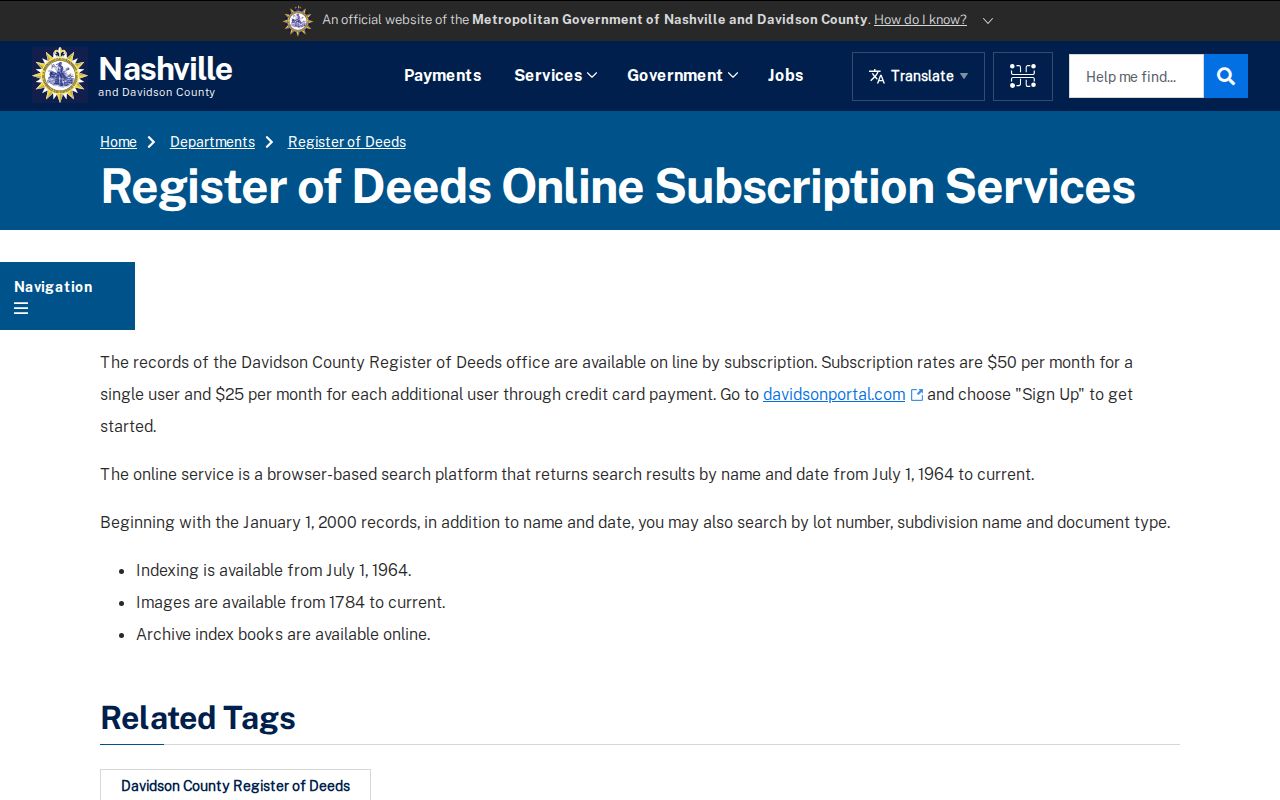
The older image and archive paths matter because a property can have an earlier legal history even when a current portal query does not return a name result.
Note: Cite the portal, archive book, reel, or deed volume used for each link in a title chain.
Nashville Old House Sources
The Metro Archives Research Your Old House guide provides the local sequence after the current deed: deed indexes, city directories, Sanborn maps, plats, Chancery records, vertical files, and the Cultural Resources Survey. Sanborn sheets can show building footprints, use, lot relationships, and street context. Plats can clarify lots and subdivisions. Neither proves who was present at an address on a given day.
Metro Archives cannot generally supply an individual property's blueprints, renovation plans, permits, or photographs unless a historical collection holds them. Current permit work belongs with Codes or ePermits. When asking Metro Archives for help, provide the name, approximate date, county, address or neighborhood, record type, and spelling variants.
TSLA's Davidson County fact sheet adds a second historical path: direct and reverse deed indexes from 1784 to 1871, county court and will material, tax books, WPA records, and newspapers. TSLA says its microfilm is loaned through Tennessee libraries. Record the reel, volume, page, and repository because a reel title does not guarantee a person-level index for every entry.
Nashville Household Timing Records
Directories create the household layer of a previous residents search. Metro Archives reports Nashville directory coverage from 1853 to 2011. Volumes from 1853 to 1909 are name-only in the guide, while directories from 1910 onward include names and street addresses. Pre-1963 volumes primarily cover the official city limits, so a Davidson address may require a suburban directory or a different place label. The Nashville Directory Book collects the directory holdings and date ranges.
- Choose an address-arranged directory year close to the period under review and record the street spelling and ward exactly as printed.
- Follow the listed name through earlier and later annual volumes, noting changes without assuming the move date.
- Pair directory years with the applicable census schedule, comparing the address, household, and place label as separate fields.
- Test a name or address against the deed chain, obituary, cemetery entry, or probate file when the directory trail ends.
Note: A directory volume records a publication-year listing, not an undated claim that someone owned or occupied the address.
Nashville Title and Household Roles
Previous residents are not found by simply copying names from a deed. A parcel owner may be a trust, company, estate, or person receiving tax correspondence elsewhere. A deed can name a grantor, grantee, attorney, trustee, executor, or witness. A directory can place a person at an address for one publication year. Keep title, mailing, household, and court roles separate. This is especially important where an estate or organization appears in the chain, because its address may be a contact point rather than a home.
The Parcel Viewer and Assessor identify a situs address and a tax mailing address separately. A homestead or exemption field can supply owner-occupancy context but cannot settle a household question on its own.
Nashville Previous Residents Probate Trail
A jump in the deed chain can lead to probate or Chancery rather than a simple sale. Start Davidson CaseSearch with the Probate office, party name, party role, and filing-date range. The free search excludes images, so a full estate file may need to be requested from the Probate or Circuit Clerk. Wills and inventories can name heirs, relationships, addresses, property, and an executor where filed. Those roles help explain a transfer, but they do not make every named person a past resident.
The Davidson CaseSearch and CaseLink entry point covers Circuit, Probate, and General Sessions Civil searching. For a partition, foreclosure, equity issue, or quiet-title question, the Chancery Clerk and Master file room is the relevant custody path.
Nashville Historic Street Checks
An old address can seem to vanish because the street name, ward, municipality, or numbering changed. Compare the printed street spelling to historic maps, plats, deeds, and the Historic Preservation street-name reports. Research notes recent reports such as Roehrig Court becoming Magnolia Shores and South Street becoming King Hollands Avenue; verify the individual report before assigning a former name to a parcel.
Metro government took effect on April 1, 1963. Berry Hill, Belle Meade, Forest Hills, Goodlettsville, and Oak Hill retained municipal identities. Use the place label and date carried by the historical source instead of silently converting every Davidson County address to Nashville.
The 1856 Davidson County fire is another reason to verify survival record by record. Surviving deed books, court minutes, newspapers, church material, and archive indexes should be checked independently rather than treated as one complete set.
Note: A changed street name is a crosswalk problem to test, not proof that a household moved.
Nashville Address Geography Checks
Postal geography is another historical trap. ZIP codes are delivery-routing labels, not proof of municipal limits, neighborhood, or occupancy. The Parcel Viewer can filter by ZIP, but it returns parcels rather than a household list. Keep postal city, municipality, county, neighborhood, parcel situs, and tax mailing address as separate values. Metro identifies 37232 and 37240 as Vanderbilt-associated institutional ZIPs, so an address in either needs institutional review before it is used in a household history.
Nashville Previous Residents Limits
Public records have gaps. A missing name can reflect a lost volume, boundary change, spelling variant, nonregistration, or an unindexed series. The 1856 Davidson County fire is a reason to check record survival series by series, not a reason to assume all county material was lost. Parcel records also do not provide Social Security numbers, driver-license information, confidential utility data, or protected addresses. Keep a discrepancy note when sources disagree.
Lawful use. Nashville previous residents research supports family history, estate questions, and personal house history. Never use an address trail to stalk, harass, intimidate, or harm a living person.
Note: A no-result should be recorded with the source and search date rather than converted into a claim about a person.