
Finding Nashville Residents Through Records
No Nashville office maintains a complete public roll of every person who lives here. Instead, each custodian records a different relationship: a parcel owner, a registered voter, a party to a deed, a court participant, or a household listed in a period directory. Begin with the source that fits the question. A current address is usually best checked through the property tools. A name tied to an estate belongs with probate. A past household belongs with the library and archives. A name-only match is weak evidence, especially for a common name.
Keep owner, occupant, mailing recipient, court party, and historical household as separate roles. The Metro Assessor may show an owner and tax mailing address, while a deed records the people who signed an instrument. Neither item alone establishes present occupancy. Nashville resident research is stronger when the name, place, and date agree across two independent records.
- Search the Metro Assessor or Parcel Viewer by owner, address, or parcel to identify the property and its situs address.
- Use the Tennessee voter form only when the required name and birth details are known, then keep the result date.
- Check the Register of Deeds for the recorded-property trail and test grantor and grantee spellings.
- For an older Nashville household, compare annual city directories, newspapers, cemetery material, and archive indexes.
- When a record is not online, ask the actual custodian for an existing file, image, or export with a clear date range.
Note: A missing search result can reflect spelling, privacy protection, an older record series, or a different custodian rather than absence.
Nashville Record Offices for Residents
Nashville and Davidson County operate under a consolidated Metro government, yet the records remain divided by purpose. The Assessor handles current parcel and tax context. The Register of Deeds holds recorded instruments. The Election Commission manages registration services. The County Clerk handles marriage-license and other clerk services. For a broad Metro department request, the Metropolitan Clerk coordinates many departments, but the Register, courts, Sheriff, Police, Health, and other custodians use their own routes.
Davidson County Register of Deeds
300 Deaderick St.
Nashville, TN
615-862-6790
Metro Assessor of Property
700 President Ronald Reagan Way, Suite 210
Nashville, TN
615-862-6080
Davidson County Election Commission
1281 Murfreesboro Pike, 3rd Floor
Nashville, TN
615-862-8800
The Davidson County Clerk is another useful Nashville contact for recent marriage-license records and clerk services. Its Howard Office Building office is at 700 President Ronald Reagan Way, Suite 101, and its published phone is 615-862-6050.
The Davidson County Clerk services page is captured below and identifies a local custodian, not general proof of where a named person lives.
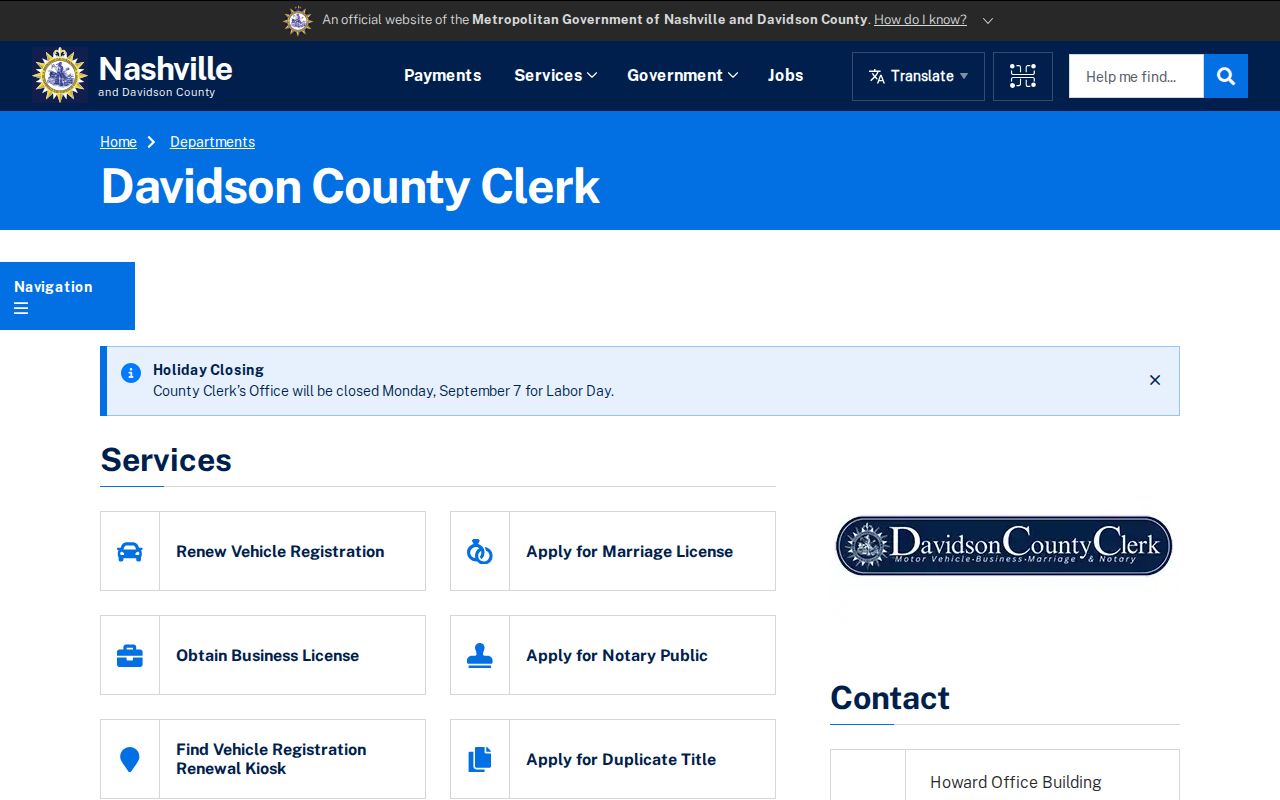
County-clerk records help answer event and license questions, while parcel ownership and resident history need their separate Nashville sources.
Nashville Parcel Search Fields
The Metro Assessor and Tennessee Property Assessment Data provide the starting point for an address or current-owner question. The state interface supplies a Davidson link and lets a searcher narrow by owner, property address, subdivision, classification, sale-date range, or a structured parcel identifier. The local property tools can then connect that result to the property’s situs address, tax mailing address, sales, exemptions, maps, and deed references. A situs address is the physical taxable property. A mailing address is where tax correspondence goes, which may be somewhere else.
| Metro property field | Format | Use in a Nashville search |
|---|---|---|
| County | Dropdown | Select Davidson County. |
| Owner Name | Optional text | Try a full name or initial form. |
| Property Address | Optional text | The street number may be omitted. |
| Subdivision or classification | Text or dropdown | Use when the address is incomplete. |
| Sale dates | Optional date pair | Limit a Nashville sale-history search. |
| Parcel ID | Control map, group, parcel | Use the displayed split identifier format. |
Metro’s property-search portal is shown in this local capture. Its purpose is to find a parcel and its recorded context before drawing conclusions about a person.
A parcel card can show owner, address, parcel ID, value, sale, and exemption data when populated. Confirm the current legal instrument with the Register of Deeds, since a tax roll is not a title opinion.
Nashville Residents Directory, Parcel First
For a Nashville address, the Parcel Viewer is often more specific than a broad name search. It accepts a parcel address or intersection, current owner, street name, and custom shape. Its advanced controls include parcel ID, owner, street, description, city, ZIP Code, acreage, sale date and price, zoning, overlay district, land use, council district, and tax district. Results can be printed or exported, and Metro documents tabs for ownership, property, zoning, assessment, and permit history.
The viewer’s useful distinction is geographic. It helps locate the parcel and nearby parcels, but it does not replace a survey, legal description, title examination, or official tax record. A trust, company, estate, or distant mailing recipient can appear as the current owner. For a full named-street trail, the Nashville street directory follows the address-focused records in more detail.
- Parcel
- A legal and tax unit mapped by Metro, not a list of its occupants.
- Situs address
- The mapped property address, separate from the tax mailing address.
- Index
- A finding tool that points to a record; it is not necessarily the record image.
- Criss-cross directory
- An address-arranged historical directory used to move from a street to a period household listing.
Nashville Deed Index Has a 1964 Divide
The Davidson County Register of Deeds supplies the property-document bridge between a person and a parcel. Its online description says the searchable name-and-date index begins July 1, 1964. Scanned images reach from 1784 to the present, and archive index books are also online. That split is important: an old document image may exist even when the modern online name search cannot reach its date. For older research, combine the portal with archive books, microfilm, and Metro Archives help.
DavidsonPortal documents name or party-name and date searching, with lot number, subdivision name, and document-type filters added for records beginning January 1, 2000. A deed chain should preserve each party’s role, recording date, document type, legal description, and prior reference. Test both grantor and grantee spellings. A grantor transfers an interest; a grantee receives one. Those roles document an instrument, not a resident status.
The Davidson County Register of Deeds is the source shown in this local capture.
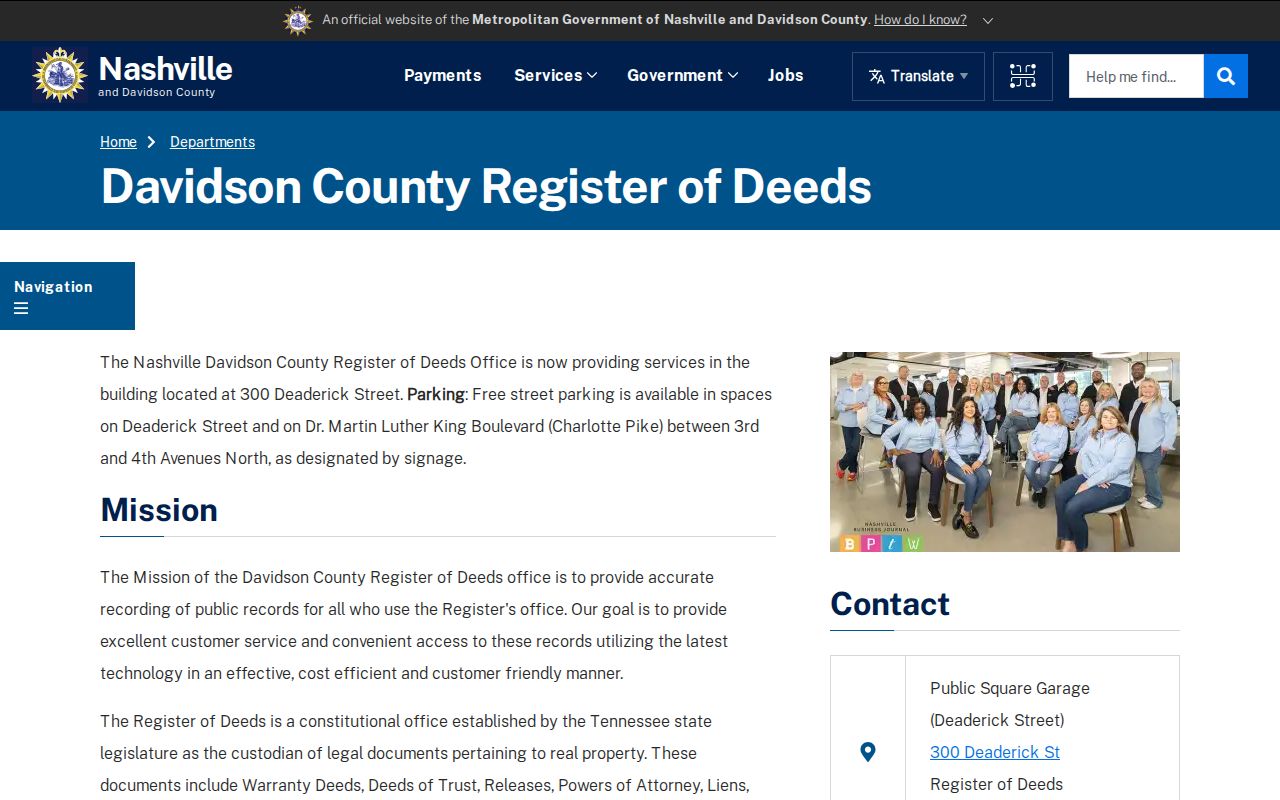
Its office lists deeds, deeds of trust, releases, liens, plats, powers of attorney, UCC filings, and court orders among the recordable instruments it maintains.
Note: The online service is subscription-gated, so verify current access and copy terms with the Register before relying on a search path.
Nashville Voter Confirmation Needs Five Fields
Tennessee’s voter lookup is a confirmation form, not a street-wide browser. It requires County, First Name, Last Name, Birth Month, and Birth Year before submission. Enter the name as registered, including a middle name or initial when known, and retain the displayed current-data date. A no-match response directs the user to check the information and contact the county election commission.
Permanent registration records are open to Tennessee citizens under T.C.A. § 2-2-127, with Social Security numbers redacted. Davidson’s voter-list order route has a political-purpose certification and should not be treated as a broad address directory. The online form can help confirm a matching record, but a registered address does not guarantee that a person occupies that premises today.
Tennessee’s voter-registration lookup provides the Nashville confirmation form shown here.
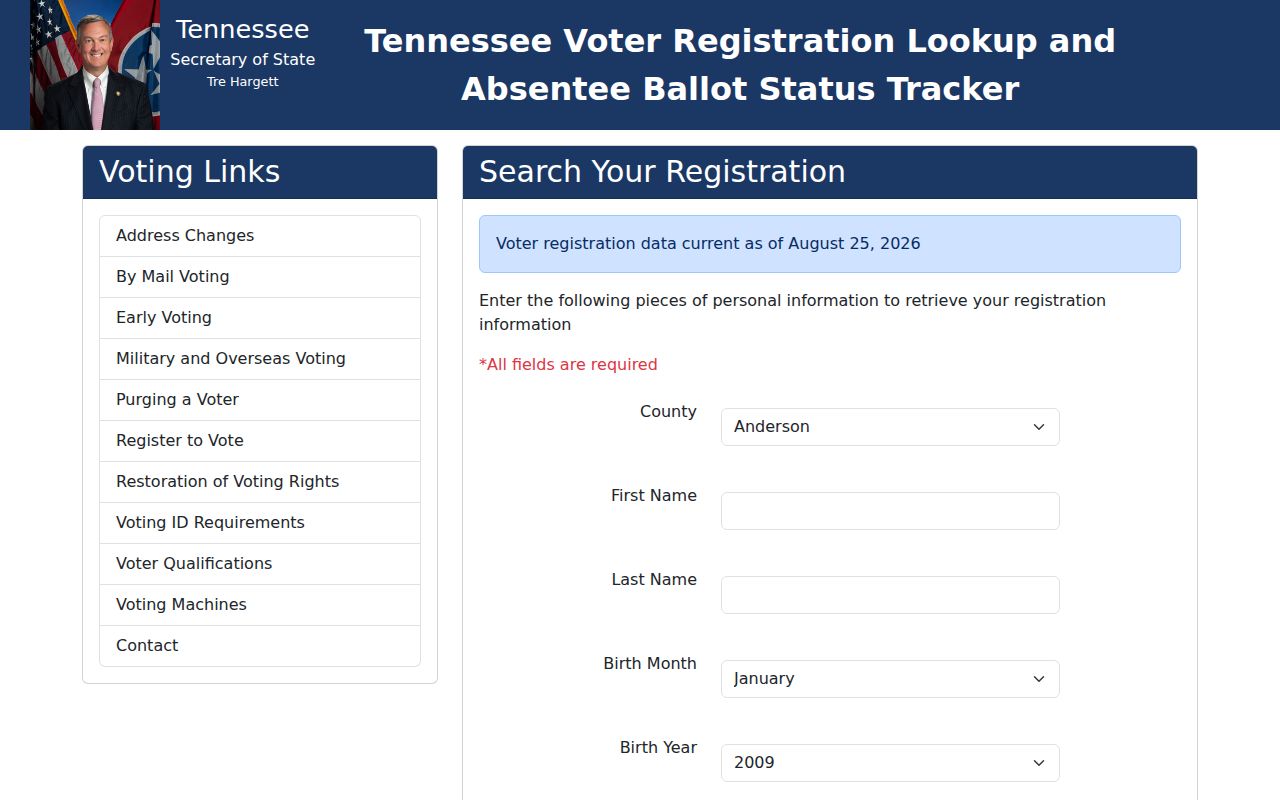
Safe at Home participants have protected registration information, so a no-match or substitute address may reflect confidentiality rather than an absent record.
Current Nashville Resident Directory Sources
Current sources have distinct strengths and limits. Parcel tools connect a current owner to land or a mailing address. Voter confirmation can establish a matching registration record under its required-field rules. The deed index places parties in an instrument. Court searches can establish a filing role and date. Public business and license results identify a filing or licensed role, but do not establish a private address. Treat each result as dated evidence rather than a profile.
| Nashville source | What it can establish | Custodian | Access boundary |
|---|---|---|---|
| Property search and Parcel Viewer | Parcel, owner, situs and mailing context | Metro Assessor and GIS | Public tools; owner is not automatically occupant |
| Voter confirmation | Matching registration and election contact path | Tennessee and Davidson elections | All five fields required; protected fields withheld |
| Davidson deed index | Parties and recorded-property trail | Register of Deeds | Modern index begins in 1964; subscription service |
| Civil and probate CaseSearch | Party role, case type, and filing date | Circuit Court Clerk | Free search excludes images |
| State license search | Public license role and status | Commerce and Insurance | Role or office is not home-address proof |
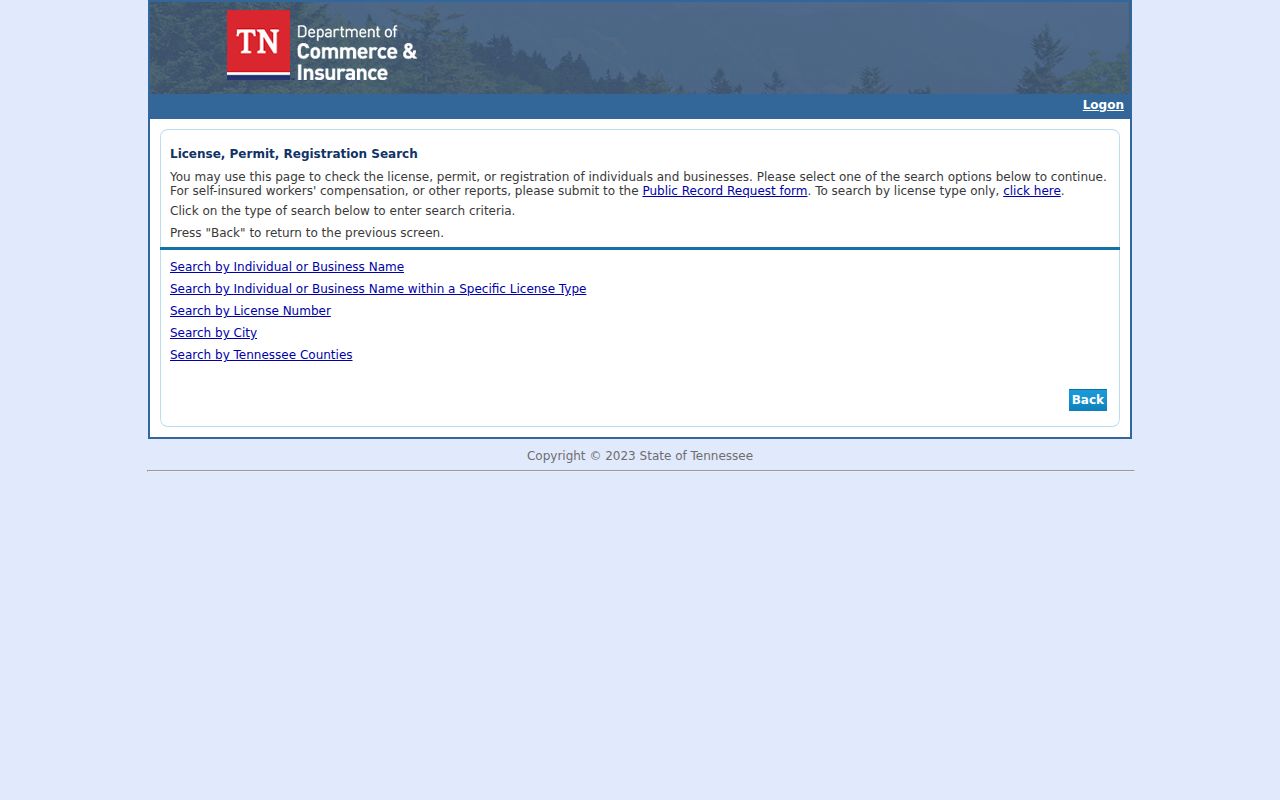
Tennessee’s license, permit, and registration search is included in the home image set because it offers individual or business name, license type, number, city, and county modes.
Use a public role only to locate the right agency record. A business address, registered office, or license location is not proof that a person lives there.
Nashville Official Sources Compared
Official Nashville record systems state what they hold, who maintains the material, and how access changes by record type. Unattributed copied listings may be convenient, but they often omit the source date, party role, coverage limit, and correction path. That makes them a poor starting point when a name is common or an address has changed.
| Question | Official Nashville source | Unattributed copied listing |
|---|---|---|
| Who owns a parcel? | Assessor, Parcel Viewer, then deed record | May confuse owner and occupant |
| Who appears in a past household? | Metro Archives city directory by year | May omit the publication date |
| What did a court index show? | Clerk portal and clerk counter | May omit role, date, or result limits |
| How is an error corrected? | Named custodian and source record | Often has no clear custodian |
Use the original portal or repository page, record the retrieval date, and preserve a record’s limits. It is safer to state “listed at this Nashville address in a dated source” than to label someone a current resident without support.
Nashville ZIP Labels Need a Second Check
Nashville postal labels are useful search filters, but they are not municipal boundaries or proof of occupancy. Metro’s Parcel Viewer can narrow property records by ZIP Code, and its GIS ZIP layer exposes ZIP and post-office-name fields. A ZIP result returns parcels, not people. Check the parcel situs, municipality, and tax information before treating a mailing label as a Nashville location.
The local geography has clear exceptions. ZIP 37232 and 37240 are Vanderbilt-associated institutional ZIPs. ZIP 37204 can include 12 South, Belmont-Hillsboro, and Berry Hill vicinity, while 37205 can span Belle Meade, West End, and Hillwood context. Neighborhood labels are orientation clues, not official boundaries. A ZIP can also cross historic communities, municipal lines, or county edges.
Note: Keep postal city, municipality, neighborhood, parcel situs, and tax mailing address as separate Nashville research fields.
Nashville Metro Geography and Family Searches
For family history and reconnecting research, the location label on a Nashville record matters as much as the name. Davidson County was established in 1783. Nashville and Davidson County adopted the Metropolitan Government charter in 1962, and implementation began April 1, 1963. Belle Meade, Berry Hill, Forest Hills, Goodlettsville, and Oak Hill retained municipal charters. Older material may use a ward, a former city label, a suburban community, or Davidson County instead of the label used today.
Metro Archives and the Nashville Public Library help preserve those distinctions. A request works best with a full name, approximate date, county, address or neighborhood, record type, and spelling variants. For a family trail, pair a date-stamped parcel or deed result with an obituary, probate file, city directory, cemetery source, or newspaper. Each source answers a narrow question and should retain its original geography.
The Metro Assessor’s official property page is the source for this local record image.

The Nashville research sequence is strongest when a modern property record and an older archive record agree on the period, address, and person’s role.
Nashville Requests Go to the Custodian
The Tennessee Public Records Act, T.C.A. §§ 10-7-501 through 10-7-516, generally lets Tennessee citizens inspect open existing records. It does not require an office to build a new resident list, answer a research question, or reorganize an unstructured database. Nashville’s central request route is useful for many Metro departments, but it does not replace a request to the Assessor, Register of Deeds, court clerk, Elections, Codes, Police, Sheriff, or Health office when that office controls the record.
A useful request names the custodian, record series, date range, address, parcel, or person identifier, and whether inspection or copies are wanted. Metro says it generally responds within seven business days with production, denial, a request for clarification, or a statement that more time is needed. Inspection of open Metro records is generally free; the listed copy schedule includes $0.15 for a black-and-white page and $0.50 for a color page, with other costs in the policy.
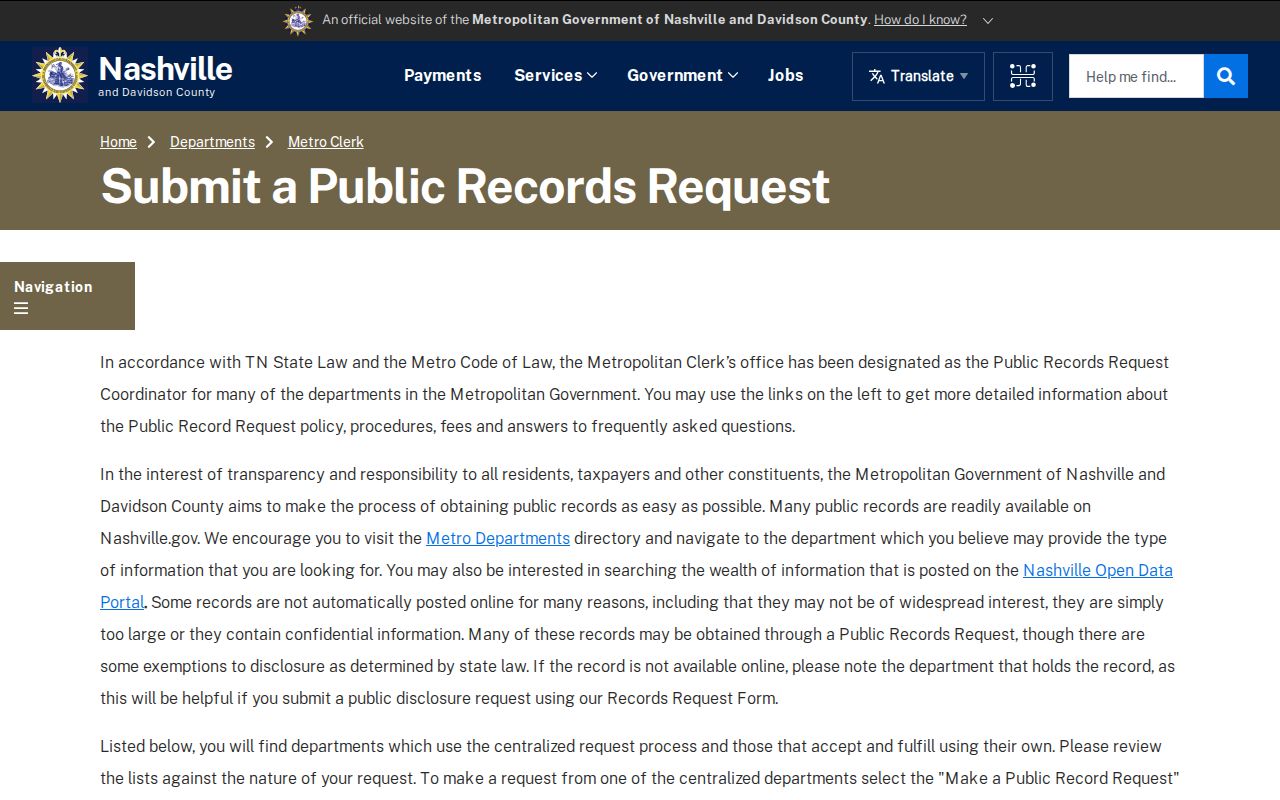
Metro’s public-records request page is shown in this local capture.
Ask for the existing item and preserve the response, dates, redactions, and any correction route supplied by the records office.
Historic Nashville Residents Directory Shelf
Metro Archives says Nashville city directories run from 1853 through 2011. The archive guide describes volumes from 1853 through 1909 as name-only; from 1910 forward, the format includes names and street addresses. Suburban directories begin appearing in the 1950s. That matters for Donelson, Madison, Goodlettsville, Oak Hill, Belle Meade, and other places where “Nashville” did not cover the full Davidson geography at the time.
For a dated household, search an address-arranged or criss-cross volume where available, then test the identified name in nearby annual volumes, deeds, newspaper notices, or probate records. The Tennessee State Library and Archives digitized Nashville volume list includes 1853/54, 1855/56, 1857, 1859, 1860/61, 1865 through 1871, 1880/81, and 1924. The full collection method is expanded in the Nashville Directory Book.
Note: A city-directory entry documents a period listing, not a present address, legal ownership, or an unchanging family relationship.
Nashville Cemetery Records Preserve Kin Links
Nashville City Cemetery and Metro Archives add a useful historical layer when a person is deceased. The archives guide identifies lot deeds, pauper lists, and interments, while the Nashville Public Library lists an interment database for 1846 through 1979. Lot deeds can name people connected with a burial lot, but lot owner, decedent, and relative named in an obituary may be different people. Compare a cemetery result with a death record, obituary, probate file, or a dated directory line.
Some gaps are part of the Nashville record story. Metro Archives reports that Mount Ararat’s official interment records were lost and that its survey is partial. It also withholds some private-cemetery locations. An absent result is therefore a documented limitation, not proof that no burial or family connection existed.
Nashville Resident Records Have Limits
Open Nashville sources do not make every address or personal detail public. Tennessee protects categories that include public-employee residential information, private utility records, driver information, protected voter fields, sensitive vital-record details, juvenile material, sealed material, expunged material, and Safe at Home participant information. A court or property result should never be expanded into a targeting profile or used to infer missing facts.
When a source appears wrong, keep its exact URL, retrieval date, spelling, and record role, then contact the agency that owns it. The Davidson Election Commission handles voter corrections, the Assessor handles assessment questions, the Register addresses recorded documents, and court questions belong with the relevant clerk. A careful Nashville record search records uncertainty instead of filling it with an assumption.